


Whether you are hiring a skip, arranging commercial waste collections or clearing unwanted materials from your property, choosing an authorised waste collection provider is essential.
Individuals and businesses involved in transporting waste may be legally required to hold a waste carrier registration, commonly referred to as a waste carrier licence.
Using an unauthorised waste collector can increase the risk of illegal waste disposal, environmental damage and potential legal consequences.
But what is a waste carrier licence, who needs one and how can you check whether a waste management company is registered?
In this comprehensive guide, we explain everything households and businesses need to know about waste carrier registration in England.
What Is a Waste Carrier Licence?
A waste carrier licence is the commonly used term for a registration that authorises an individual or organisation to transport waste as part of their business activities.
In England, waste carrier registrations are administered by the Environment Agency.
Registered organisations can be identified through a publicly accessible register, allowing customers to check their waste provider’s registration details.
Waste carrier registration forms an important part of the regulatory framework designed to support responsible waste management and prevent illegal waste activities.
However, holding a registration does not automatically authorise an organisation to store, treat or dispose of waste at any location.
Separate environmental permits or applicable exemptions may be required for these activities.
Why Are Waste Carrier Licences Important?
Waste carrier registration helps support accountability throughout the waste management industry.
It allows households and businesses to identify registered operators before arranging waste collections.
Using an appropriately registered waste carrier can help customers:
- Meet their waste duty of care responsibilities
- Reduce the risk of illegal waste disposal
- Protect the environment
- Establish accountability for waste collections
- Reduce potential compliance risks
- Make informed decisions when choosing waste providers
Registration is an important initial check, but customers should also consider where their waste is going and whether it will be managed appropriately.
Who Needs a Waste Carrier Licence?
Waste carrier registration may be required when individuals or businesses transport waste as part of their commercial activities.
Examples of businesses that may require registration include:
- Skip hire companies
- Commercial waste collection companies
- House clearance businesses
- Man and van waste removal services
- Builders
- Plumbers
- Electricians
- Gardeners and landscapers
- Demolition contractors
- Scrap metal collectors
- Maintenance contractors
- Waste brokers
- Waste dealers
The appropriate registration depends on the activities undertaken and the types of waste involved.
Businesses should consult the Environment Agency if they are unsure which registration applies to their circumstances.
What Is the Difference Between a Waste Carrier, Broker and Dealer?
Although these terms are often used together, they describe different activities within waste management.
Waste Carrier
A waste carrier transports waste between locations.
For example, a skip hire company collecting waste from a construction site acts as a waste carrier.
Waste Broker
A waste broker coordinates waste management arrangements on behalf of another organisation.
For example, a broker may arrange collections through third-party waste management providers without operating its own collection vehicles.
Waste Dealer
A waste dealer acts as a principal in transactions involving waste, such as purchasing waste materials for subsequent sale.
A dealer does not necessarily need to take physical possession of the materials.
An organisation may undertake more than one of these activities and must ensure its registration reflects the services it provides.
What Are Lower Tier and Upper Tier Waste Carrier Registrations?
In England, waste carrier registrations are divided into two categories: lower tier and upper tier.
The appropriate category depends on the activities undertaken and the circumstances in which waste is transported or managed.
Lower Tier Waste Carrier Registration
Lower tier registration generally applies to organisations transporting waste generated through their own business activities, excluding construction and demolition waste.
Certain charities, voluntary organisations and businesses handling specific categories of waste may also qualify.
Lower tier registrations do not require routine renewal.
Upper Tier Waste Carrier Registration
Upper tier registration generally applies to commercial waste collection businesses, organisations transporting other people’s waste and businesses carrying construction or demolition waste.
It also applies to many commercial waste brokers and dealers.
Upper tier registrations must be renewed every three years.
Upper Tier vs Lower Tier Waste Carrier Registration
| Registration Feature | Lower Tier | Upper Tier |
|---|---|---|
| Transporting your own ordinary business waste | Generally applicable | Depends on circumstances |
| Collecting other people’s waste commercially | Generally not applicable | Generally required |
| Transporting construction and demolition waste | Generally not applicable | Generally required |
| Commercial waste brokerage | Limited circumstances | Generally required |
| Routine renewal | Not required | Every three years |
| Registration charge | Generally free | Applicable registration fee |
Certain exemptions and special circumstances may apply. Businesses should check current official guidance before selecting a registration category.
Do Builders Need a Waste Carrier Licence?
Builders and construction contractors may require waste carrier registration when transporting materials generated through construction, refurbishment or demolition activities.
Common examples include:
- Bricks and rubble
- Concrete
- Timber
- Plasterboard
- Removed fixtures and fittings
- Excavated materials classified as waste
- Construction packaging
Construction and demolition waste is treated differently from ordinary waste generated through a business’s own operations.
Even where a builder has generated the construction waste themselves, upper tier registration is generally required when transporting it as part of their business.
Alternatively, construction companies can arrange for an appropriately registered waste management provider to collect the materials directly.
Do Gardeners and Landscapers Need a Waste Carrier Licence?
Gardeners and landscaping businesses may require waste carrier registration when transporting waste generated or collected through their work.
Common materials include:
- Grass cuttings
- Hedge trimmings
- Branches
- Soil
- Turf
- Removed fencing
- Landscaping materials
The registration category depends on factors including who produced the waste and whether it originated from construction or demolition activities.
Landscaping businesses should assess their individual activities before transporting waste from customer premises.
Do Scrap Metal Collectors Need a Waste Carrier Licence?
Businesses collecting and transporting scrap metal generally require appropriate waste carrier registration.
Depending on their activities, they may also require a scrap metal dealer’s licence from the relevant local authority.
Waste carrier registration and a scrap metal dealer’s licence are separate requirements.
Customers arranging scrap metal collections should establish whether the collector holds all relevant authorisations.
Do House Clearance Companies Need a Waste Carrier Licence?
Businesses collecting unwanted furniture, household rubbish and other waste from customer properties generally require appropriate waste carrier registration.
This includes businesses operating through online marketplaces, social media advertisements and independent man and van services.
Customers should check a house clearance company’s registration before arranging a collection, regardless of the size or cost of the job.
Do Householders Need a Waste Carrier Licence?
Private householders transporting their own household waste to an authorised household waste recycling centre do not generally need waste carrier registration.
However, householders arranging for someone else to remove their waste must take reasonable measures to ensure that the recipient is authorised to accept it.
This applies when arranging services such as:
- Domestic skip hire
- House clearances
- Garden waste removals
- Furniture collections
- Man and van waste removals
- Bulky waste collections
Checking the provider’s registration is an important precaution.
Different requirements may apply where waste is generated through business activities at a residential property.
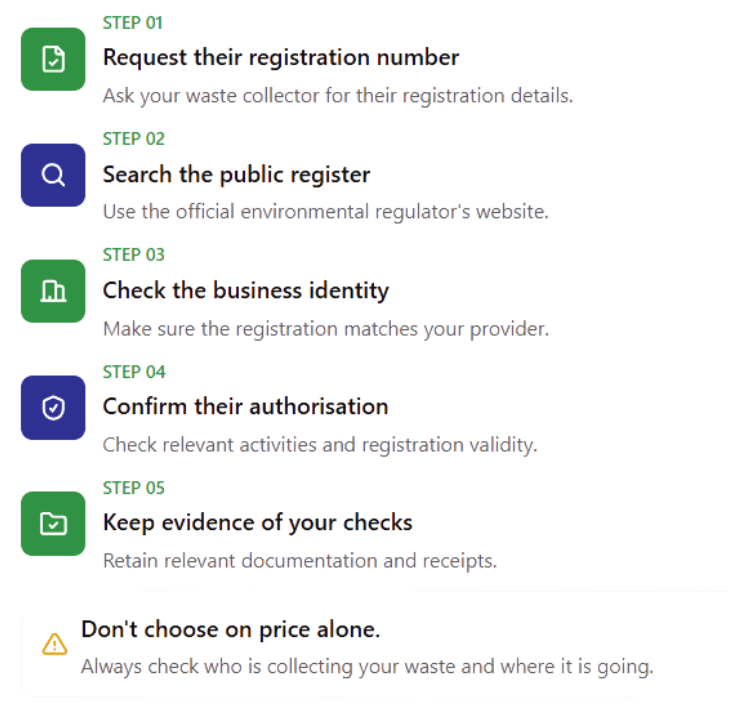
How Do You Check a Waste Carrier Licence?
Customers can check an England-registered waste carrier using the Environment Agency’s online public register.
The register is accessible free of charge and allows users to search for registered waste carriers, brokers and dealers.
Step 1: Request the Registration Number
Ask the waste collection provider for its current waste carrier registration number.
A reputable provider should be able to supply its registration details.
Step 2: Visit the Environment Agency’s Public Register
Search the official Register of Waste Carriers, Brokers and Dealers.
Using the official register is preferable to relying solely on a certificate, advertisement or screenshot supplied by the collector.
Step 3: Search for the Organisation
Enter the relevant registration number or business details into the search facility.
Step 4: Review the Registration Details
Check that the registered organisation matches the business you intend to use.
Review the registration category, relevant activities and expiry information where applicable.
Step 5: Keep Evidence of Your Checks
Businesses should maintain appropriate records of the checks they undertake.
Householders may also benefit from retaining registration information, collection receipts and other relevant correspondence.
These records can help demonstrate that reasonable precautions were taken when arranging waste removal.
What Does a Waste Carrier Registration Number Look Like?
Environment Agency waste carrier registration numbers commonly begin with the letters CB.
You may encounter registration numbers beginning with:
- CBDU
- CBDL
These prefixes are commonly associated with upper tier and lower tier registrations respectively.
However, customers should not rely solely on the appearance or format of a registration number.
The registration should always be checked against the appropriate regulator’s public register.
How Long Does a Waste Carrier Licence Last?
Upper tier registrations in England must be renewed every three years.
Lower tier registrations do not require routine renewal, although registration details must remain accurate and the registration must remain valid.
Businesses should ensure that changes to their organisation or activities are communicated to the relevant regulator where required.
Customers reviewing an existing waste management contract should periodically recheck the provider’s registration rather than relying on evidence obtained several years earlier.
How Much Does a Waste Carrier Licence Cost?
The cost of waste carrier registration depends on the category of registration and the activities undertaken.
Lower tier registration is generally free, while upper tier registration and renewal may involve applicable charges.
As registration fees can change, businesses should consult the current GOV.UK registration service for accurate pricing.
Customers hiring a waste collection company do not normally need to purchase a waste carrier registration themselves simply because they are arranging a collection.
What Is the Difference Between a Waste Carrier Licence and an Environmental Permit?
Waste carrier registration and environmental permits serve different purposes.
A waste carrier registration relates to waste transportation, brokerage or dealing activities.
An environmental permit authorises specified regulated activities, such as certain waste storage, treatment, recycling or disposal operations.
| Waste Carrier Registration | Environmental Permit |
|---|---|
| Relates to specified waste management business activities | Authorises particular regulated operations |
| Commonly required for commercial waste transportation | Commonly required for waste treatment facilities |
| Registered against an individual or organisation | Relates to specified operations or facilities |
| Does not independently authorise waste treatment sites | Sets conditions for permitted activities |
Certain waste operations may instead qualify for an applicable exemption.
Businesses should establish that both the collection arrangements and receiving facilities are appropriately authorised.
Does a Waste Carrier Licence Guarantee Responsible Waste Disposal?
No.
Registration is an important compliance requirement, but it does not guarantee that every waste collection will be managed correctly.
Customers should also consider:
- The identity of the waste collection provider
- The proposed destination of the waste
- Relevant facility authorisations
- Appropriate waste documentation
- Waste acceptance requirements
- The provider’s business reputation
- Any concerns about the proposed collection arrangements
A registration certificate should never be treated as proof that waste has been recycled or disposed of correctly.
Appropriate checks and supporting documentation are important throughout the waste management process.
What Happens if You Use an Unregistered Waste Carrier?
Using an unauthorised waste collector can create significant legal, environmental and financial risks.
Waste may be transported to an unauthorised location, illegally dumped or managed through unsuitable treatment arrangements.
Potential consequences include:
- Fly-tipping
- Environmental pollution
- Illegal waste storage
- Fire hazards
- Enforcement investigations
- Financial penalties
- Reputational damage
- Additional waste removal costs
Depending on the circumstances, households and businesses may face enforcement action if they have failed to meet their waste duty of care responsibilities.
Businesses operating without required waste carrier registration may also face prosecution and substantial financial penalties.
Can You Be Fined if Someone Fly-Tips Your Waste?
Potentially, yes.
Households and businesses have legal responsibilities when transferring waste to other parties.
If waste is subsequently fly-tipped, enforcement authorities may investigate its origin and the arrangements made for its removal.
Liability is not automatically established simply because waste originated from a particular household or business.
However, failing to take reasonable precautions when appointing a waste provider may result in enforcement action.
Maintaining evidence of appropriate checks and collection arrangements can help demonstrate that responsibilities have been taken seriously.
How Can You Spot an Unauthorised Waste Collector?
Unregistered or irresponsible waste collectors may advertise through social media, online marketplaces or local advertisements.
Although a low price or small business does not automatically indicate illegal activity, customers should pay attention to potential warning signs.
Unusually Low Collection Prices
Responsible waste management involves costs associated with transportation, employees, equipment and authorised treatment or disposal.
A price significantly below comparable quotations should prompt further enquiries.
Refusal to Provide Registration Details
Customers should be cautious if a collector cannot or will not provide information that allows their authorisation to be verified.
Unclear Business Identity
A collector should be able to provide sufficient information to identify the individual or organisation undertaking the work.
No Information About Waste Destinations
Customers should be cautious if a collector refuses to explain how or where waste will be managed.
Missing Waste Documentation
Commercial waste transfers generally require appropriate documentation.
An unwillingness to provide legally required records should raise concerns.
Pressure to Arrange an Immediate Collection
Customers should not feel pressured into accepting a waste removal service before completing reasonable checks.
No individual warning sign necessarily proves illegal activity, but a combination of concerns should encourage customers to investigate further.
What Should You Check Before Hiring a Skip?
Hiring a skip is a convenient way to manage waste from home improvements, construction projects, clearances and commercial activities.
Before booking, customers should consider the following:
- Verify the waste carrier registration.
- Confirm the identity of the skip hire provider.
- Check which materials are accepted.
- Establish whether a skip permit is required.
- Confirm collection and delivery arrangements.
- Understand the applicable waste documentation.
- Ask how waste will be managed after collection.
- Review the quotation and service terms.
Choosing a responsible skip hire company can help ensure waste is managed appropriately throughout the collection and treatment process.
What Should Businesses Check Before Appointing a Waste Management Company?
Commercial customers should establish appropriate procedures when selecting a waste management provider.
A business waste compliance review may include:
| Compliance Area | Recommended Check |
|---|---|
| Waste carrier registration | Verify appropriate registration |
| Environmental permits | Confirm relevant facility authorisations |
| Waste transfer documentation | Establish how transfers will be recorded |
| Waste classification | Confirm appropriate waste descriptions and codes |
| Waste separation | Review available recycling arrangements |
| Waste destinations | Establish where materials will be managed |
| Insurance | Review relevant insurance arrangements |
| Collection arrangements | Confirm service frequency and suitability |
| Environmental reporting | Establish what performance evidence is available |
| Ongoing compliance | Periodically review provider documentation |
These checks can be incorporated into procurement procedures, supplier assessments and internal environmental audits.
What Legislation Governs Waste Carrier Registration?
The principal legislation relevant to waste carrier registration in England includes:
- The Control of Pollution (Amendment) Act 1989
- The Environmental Protection Act 1990
- The Waste (England and Wales) Regulations 2011
Other legislation may apply depending on the nature of the waste and the activities undertaken.
The waste duty of care provisions within the Environmental Protection Act 1990 are particularly relevant when transferring waste to another person or organisation.
Businesses should consult current official guidance to understand their individual responsibilities.
Waste Carrier Registration Across the UK
Waste regulation is administered by different environmental regulators across the UK.
| Country | Environmental Regulator |
|---|---|
| England | Environment Agency |
| Wales | Natural Resources Wales |
| Scotland | Scottish Environment Protection Agency |
| Northern Ireland | Northern Ireland Environment Agency |
Appropriate registrations issued in Scotland or Wales can also authorise relevant activities in England.
Businesses operating across national boundaries should check the applicable requirements rather than assuming every jurisdiction operates under identical rules.
How Does Waste Carrier Registration Help Protect the Environment?
An effective registration system supports accountability across the waste management industry.
By choosing appropriately registered and responsible waste providers, households and businesses can help reduce opportunities for illegal waste activities.
Responsible waste management can contribute towards:
- Preventing fly-tipping
- Reducing environmental pollution
- Protecting wildlife and natural habitats
- Supporting material recovery
- Improving recycling opportunities
- Reducing illegal waste storage
- Promoting responsible resource management
However, registration must be supported by appropriate waste handling, documentation and authorised treatment arrangements.
Frequently Asked Questions About Waste Carrier Licences
What is a waste carrier licence?
It is the commonly used term for registration authorising an individual or organisation to undertake relevant waste transportation activities.
Is a waste carrier licence a legal requirement?
Yes, where the waste transportation activities undertaken require registration under applicable legislation.
How can I check if someone has a waste carrier licence?
You can search the relevant environmental regulator’s public register using the organisation’s details or registration number.
Is it free to check a waste carrier licence?
Yes. The Environment Agency’s online register is available to the public free of charge.
How often does a waste carrier licence need renewing?
Upper tier registrations in England require renewal every three years. Lower tier registrations do not require routine renewal.
Do builders need a waste carrier licence?
Builders transporting construction or demolition waste as part of their business generally require upper tier registration.
Do I need a waste carrier licence to take my own household rubbish to the tip?
Private individuals transporting their own household waste for personal purposes do not generally require registration.
Does a waste carrier licence allow a company to operate a waste transfer station?
No. Operating a waste transfer station generally requires separate environmental authorisation.
Can a waste carrier licence be revoked?
Yes. Registration may be revoked in circumstances set out within the applicable legislation, including certain relevant environmental offences.
Should I ask my skip hire company for its waste carrier registration?
Yes. Checking the registration is a useful precaution when selecting a waste collection provider.
Does a waste carrier licence prove that waste has been recycled?
No. Registration establishes authorisation for relevant activities but does not independently demonstrate recycling or treatment outcomes.
Can I get into trouble if my waste is fly-tipped?
Potentially. Households and businesses may face enforcement action where they have failed to meet applicable waste duty of care responsibilities.
Choose Responsible Waste Management With KCM Waste Management
At KCM Waste Management, we understand the importance of responsible waste collection, appropriate documentation and environmental compliance.
Established in 1986, our family-run business brings four decades of experience to the waste management and recycling industry.
We provide a comprehensive range of waste management services for domestic, commercial and industrial customers, including:
- Domestic and commercial skip hire
- Commercial waste collections
- General waste collections
- Dry mixed recycling
- Food waste recycling
- Glass recycling
- Cardboard and paper recycling
- Roll-on roll-off containers
- Grab hire
- Commercial waste tipping
- Construction waste management
- Confidential waste management
Whether you are clearing your home, undertaking a construction project or reviewing your business waste management arrangements, our experienced team is here to help.
Contact KCM Waste Management today to discuss your requirements and request information about our relevant waste management authorisations.
Call: 0800 772 0948
Email: info@kcmwaste.com
Further Guidance
For additional information, consult the Environment Agency’s public register, GOV.UK’s waste carrier registration guidance and the Waste Duty of Care Code of Practice.
This article provides general information about waste carrier registration in England and does not constitute individual legal advice. Different requirements may apply elsewhere in the UK.
Article updated: November 2026.