


Hazardous waste is generated by households, businesses, construction projects and industrial operations across the UK.
Unlike many everyday waste materials, hazardous waste contains substances or possesses properties that can present risks to human health, wildlife and the environment.
Incorrect disposal can result in fires, chemical exposure, environmental contamination and serious health and safety incidents.
Understanding how to identify, separate and manage hazardous waste is therefore essential for responsible waste management.
But what is hazardous waste, which materials are classified as hazardous and how should they be disposed of?
In this comprehensive guide, we explain the different types of hazardous waste, legal responsibilities and appropriate disposal arrangements in England.
What Is Hazardous Waste?
Hazardous waste is waste that contains substances or possesses characteristics that may cause harm to human health or the environment.
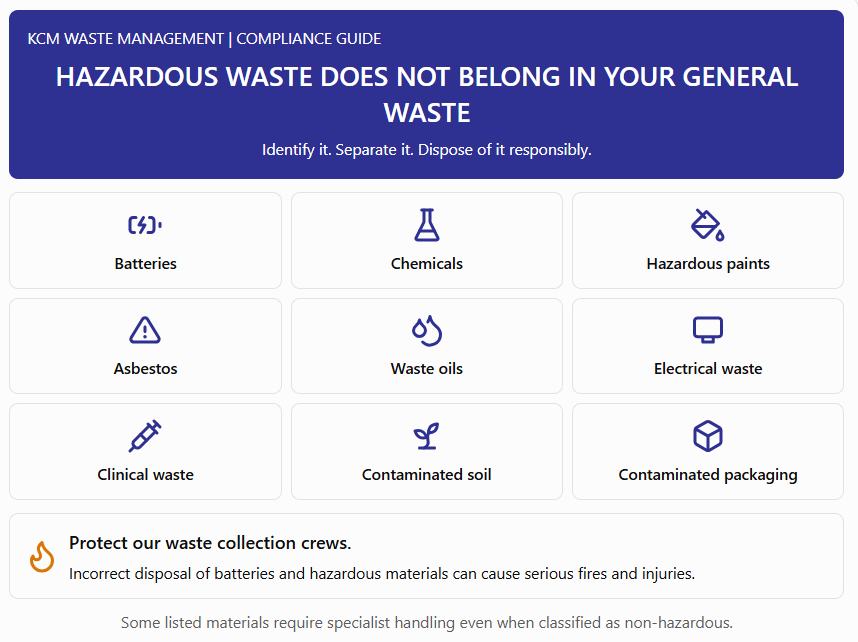
These materials require appropriate classification and additional controls to ensure they are stored, transported, treated and disposed of safely.
Hazardous waste can arise from everyday household activities as well as commercial, construction and industrial operations.
Some hazardous materials are relatively easy to identify, while others may require specialist assessment or laboratory analysis.
A material does not necessarily need to appear dangerous to be classified as hazardous.
What Makes Waste Hazardous?
Waste may be classified as hazardous because of its chemical composition, physical characteristics or potential environmental and health impacts.
Examples of hazardous properties include:
- Flammability
- Toxicity
- Corrosiveness
- Infectious properties
- Explosive properties
- Oxidising properties
- Carcinogenic properties
- Environmental toxicity
Certain waste materials may possess more than one hazardous property.
Correct classification helps determine the appropriate precautions and waste management arrangements.
Common Examples of Hazardous Waste
Hazardous waste can be found across numerous industries and everyday environments.
| Waste Material | Potential Risk |
|---|---|
| Asbestos | Exposure to harmful fibres |
| Certain batteries | Fire, chemical leakage and contamination |
| Paints and solvents | Flammability and chemical exposure |
| Waste engine oil | Environmental contamination |
| Pesticides | Toxicity and environmental damage |
| Fluorescent tubes | Potential mercury exposure |
| Contaminated soils | Potential chemical contamination |
| Certain electrical equipment | Hazardous components and fire risks |
| Refrigeration equipment | Potentially harmful refrigerants |
| Certain clinical waste | Infection and injury |
| Hazardously contaminated packaging | Exposure to residual substances |
| Certain treated timber | Potentially harmful chemical treatments |
The hazardous classification of individual materials depends on their composition, origin and characteristics.
Not every product within these categories is automatically classified as hazardous waste.
What Are the Different Types of Hazardous Waste?
Chemical Waste
Chemical waste may be generated through manufacturing, cleaning, maintenance, laboratories and industrial activities.
Examples include certain:
- Cleaning chemicals
- Acids and alkalis
- Solvents
- Adhesives
- Paints
- Industrial chemicals
- Pesticides
Chemical waste must be appropriately identified and managed to prevent exposure, leaks, spills and dangerous reactions.
Unknown chemicals should not be mixed or handled without specialist advice.
Asbestos Waste
Asbestos-containing materials may be found within older buildings and structures.
Examples include certain:
- Roofing sheets
- Insulation products
- Ceiling materials
- Floor tiles
- Pipe insulation
- Asbestos cement products
Disturbing asbestos-containing materials can release dangerous fibres into the air.
Suspected asbestos should not be broken, cut, drilled or placed into a standard skip.
A competent asbestos professional should assess the material and establish the appropriate removal and disposal arrangements.
Battery Waste
Batteries require particularly careful management because they can contain hazardous substances or present significant fire risks.
Lithium-ion batteries are commonly found in:
- Mobile phones
- Laptops
- Electric bicycles
- E-scooters
- Power tools
- Rechargeable household devices
- Disposable and rechargeable vapes
When batteries are damaged, crushed or exposed to unsuitable conditions, they may overheat and ignite.
This creates serious risks within waste collection vehicles, recycling facilities and waste transfer stations.
Batteries and battery-containing devices should never be placed into ordinary general waste bins, dry mixed recycling bins or standard skips.
They should instead be directed towards appropriate battery or electrical waste collection arrangements.
Waste Electrical and Electronic Equipment
Waste electrical and electronic equipment is commonly referred to as WEEE.
Examples include:
- Computers
- Mobile phones
- Televisions
- Refrigerators
- Freezers
- Electronic toys
- Small household appliances
- Commercial electrical equipment
Certain electrical products contain hazardous components that require specialist treatment.
Not all WEEE is classified as hazardous, but electrical waste should be separated and managed through suitable collection and recycling arrangements.
Waste Oils and Fuels
Used oils and certain fuels can cause significant environmental contamination if incorrectly disposed of.
Examples include:
- Engine oil
- Hydraulic oil
- Lubricating oil
- Fuel residues
- Certain contaminated oil filters
Waste oils must not be poured into drains, onto the ground or into watercourses.
Appropriate specialist collection arrangements should be established.
Clinical and Healthcare Waste
Healthcare activities can generate waste requiring specialist classification and management.
Examples may include:
- Infectious waste
- Contaminated medical materials
- Certain pharmaceutical waste
- Used needles and sharps
- Laboratory waste
Different healthcare waste streams have different classification and handling requirements.
Healthcare organisations must establish appropriate segregation, storage and collection procedures.
Contaminated Soil
Soil generated through excavation, demolition and redevelopment projects may contain hazardous substances.
Potential contaminants include:
- Petroleum products
- Heavy metals
- Industrial chemicals
- Asbestos-containing materials
- Other substances associated with previous land use
Contaminated soil may require specialist assessment before suitable waste management arrangements can be identified.
The appearance of soil alone cannot establish whether it is hazardous.
What Is the Difference Between Hazardous and Non-Hazardous Waste?
Hazardous and non-hazardous waste are subject to different classification and management requirements.
| Hazardous Waste | Non-Hazardous Waste |
|---|---|
| Possesses relevant hazardous properties or meets a hazardous waste classification | Does not meet the applicable hazardous waste classification |
| Requires additional management controls | Subject to standard applicable waste management controls |
| Uses an applicable EWC code with an asterisk | Uses an applicable EWC code without an asterisk |
| Generally requires consignment documentation | Generally requires waste transfer documentation |
| May require specialist treatment facilities | May be suitable for conventional recycling and treatment |
Non-hazardous waste must still be managed responsibly.
Both categories require appropriate classification, handling and authorised waste management arrangements.
How Is Hazardous Waste Classified?
Businesses must establish an appropriate classification before their waste is transferred for recovery or disposal.
Waste classification considers factors such as:
- The process that generated the waste
- Its chemical composition
- Its physical characteristics
- The presence of hazardous substances
- Potential hazardous properties
- Relevant concentration thresholds
- Available supporting evidence
The Environment Agency’s WM3 technical guidance provides the framework for classifying hazardous and non-hazardous waste.
Certain materials may require laboratory analysis or specialist assessment to determine their classification.
Businesses should not classify potentially hazardous waste based solely on its appearance or the cost of disposal.
What Are Hazardous Waste EWC Codes?
European Waste Catalogue codes, commonly known as EWC codes, are six-digit codes used to identify different waste types.
An asterisk following an EWC code identifies a hazardous waste entry.
Examples include:
| EWC Code | Waste Description |
|---|---|
| 17 06 05* | Construction materials containing asbestos |
| 17 06 01* | Insulation materials containing asbestos |
| 17 05 03* | Soil and stones containing hazardous substances |
| 17 03 01* | Bituminous mixtures containing coal tar |
| 17 02 04* | Glass, plastic and wood containing or contaminated with hazardous substances |
| 15 01 10* | Packaging containing residues of or contaminated by hazardous substances |
| 16 06 01* | Lead batteries |
| 20 01 21* | Fluorescent tubes and other mercury-containing waste |
These classifications are provided as examples only.
The appropriate code must reflect the actual waste and its characteristics.
For further information, explore our guide to EWC codes and waste classification.
What Legislation Governs Hazardous Waste?
Hazardous waste management in England is governed by several pieces of environmental legislation, including:
- The Environmental Protection Act 1990
- The Hazardous Waste (England and Wales) Regulations 2005, as amended and applicable in England
- The Waste (England and Wales) Regulations 2011
- The Environmental Permitting (England and Wales) Regulations 2016
Additional legislation may apply to particular waste types, workplace activities and transportation arrangements.
Businesses must establish which requirements apply to the materials they produce and manage.
The Environment Agency provides further guidance on hazardous waste responsibilities.
What Are a Business’s Hazardous Waste Responsibilities?
Businesses producing or holding hazardous waste have additional responsibilities alongside their general waste duty of care.
These include establishing the correct classification, maintaining safe storage arrangements, appointing appropriately authorised contractors and retaining the necessary documentation.
Businesses should ensure that employees understand which materials require dedicated handling.
An effective hazardous waste management procedure can help reduce environmental risks, workplace incidents and regulatory non-compliance.
How Should Hazardous Waste Be Disposed Of?
Hazardous waste disposal requires appropriate planning and specialist management.
The following steps provide a general overview for businesses.
Step 1: Identify Hazardous Materials
Review the waste generated throughout your operations.
Identify materials that may require hazardous waste classification or specialist treatment.
Relevant information may include product safety data sheets, manufacturing information and details of how materials have been used.
Step 2: Establish the Correct Classification
Consult the official waste classification guidance and obtain specialist assistance where necessary.
Determine the appropriate EWC code and hazardous properties before arranging collection.
Step 3: Separate Hazardous Waste
Hazardous waste should be kept separate from ordinary general waste and recycling streams.
Different hazardous materials must not be mixed indiscriminately.
Mixing incompatible materials can create serious chemical reactions, fire risks and complications during treatment.
Step 4: Arrange Appropriate Storage
Use suitable, compatible containers and storage arrangements for the materials involved.
Storage requirements will depend on the individual waste’s characteristics.
Businesses should assess risks associated with leaks, exposure, incompatible substances, unauthorised access and fire.
Step 5: Appoint an Authorised Waste Provider
Use an appropriately registered waste carrier and establish that the receiving facility is authorised to manage the particular waste.
A waste carrier registration alone does not demonstrate that a business can accept every hazardous material.
Step 6: Complete the Required Documentation
Applicable hazardous waste movements must be accompanied by appropriate consignment documentation.
Ensure that the information provided accurately reflects the materials and their handling requirements.
Step 7: Maintain Appropriate Records
Retain the relevant documentation and evidence of the waste management arrangements.
Review the process regularly, particularly when new materials are introduced or existing waste streams change.
What Is a Hazardous Waste Consignment Note?
A hazardous waste consignment note is a document used to record applicable movements of hazardous waste.
It provides detailed information about the material being transported and the organisations responsible for its management.
The document includes information about the waste’s origin, classification, quantity, hazardous characteristics, transportation and destination.
Different sections are completed by the relevant parties involved in the movement.
Businesses should ensure their consignment documentation is prepared correctly before the waste is removed.
Hazardous Waste Consignment Notes vs Waste Transfer Notes
| Waste Transfer Note | Hazardous Waste Consignment Note |
|---|---|
| Generally used for non-hazardous waste transfers | Generally used for hazardous waste movements |
| Records waste and transfer information | Includes additional hazardous waste details |
| May cover qualifying recurring collections | Subject to separate hazardous waste movement requirements |
| Generally retained for at least two years | Generally retained by hazardous waste producers for three years |
There are limited exceptions to hazardous waste consignment note requirements, including certain domestic hazardous waste movements.
Asbestos waste is subject to particular requirements.
How Long Should Hazardous Waste Records Be Kept?
Hazardous waste producers and holders in England generally need to maintain their hazardous waste register for three years.
Relevant records include consignment documentation, reports from receiving facilities and associated records relating to waste movements.
Different retention periods apply to waste carriers, brokers, dealers and receiving facilities.
Businesses should maintain an organised record management system and consult current official guidance for their specific role.
Can Hazardous Waste Be Recycled?
Yes. Certain hazardous waste materials can undergo specialist recycling or recovery processes.
Examples may include:
- Battery recycling
- Waste oil recovery
- Specialist electrical equipment recycling
- Solvent recovery
- Recovery of valuable metals
Recycling hazardous waste requires appropriate processes and authorised facilities capable of managing the associated risks.
Not all hazardous materials can be recycled.
Some require treatment to reduce their harmful characteristics before further recovery or disposal.
Can Hazardous Waste Go in a Skip?
Hazardous waste should not be placed into a standard general waste skip.
Materials that commonly require separate arrangements include:
- Asbestos
- Batteries
- Paints containing hazardous substances
- Solvents
- Chemicals
- Waste oils
- Contaminated materials
- Certain electrical equipment
Other materials, including gas cylinders and pressurised containers, may also be prohibited due to safety and facility acceptance requirements.
Before hiring a skip, customers should establish which materials are permitted.
If you are unsure whether a material is hazardous or suitable for skip disposal, contact your waste management provider before loading it.
Can Hazardous Waste Go in a General Waste Bin?
Hazardous waste should not be placed into ordinary general waste bins.
These containers are intended for appropriate residual waste materials that meet the collection provider’s acceptance requirements.
Placing hazardous materials into general waste can expose collection crews and waste processing employees to serious risks.
Batteries, chemicals, electrical equipment and other specialist waste materials must be managed through suitable separate arrangements.
Why Are Batteries Particularly Dangerous in General Waste?
Batteries are increasingly present within everyday products, including toys, electronic devices, vapes and rechargeable household equipment.
Lithium-ion batteries can be damaged during waste collection, transportation and processing.
Waste collection vehicles may compact materials to increase their carrying capacity.
When batteries are crushed or damaged, internal short circuits can trigger overheating and potentially lead to a process known as thermal runaway.
This can result in rapidly developing fires that are difficult to manage.
Battery-related fires can endanger:
- Waste collection drivers
- Recycling facility employees
- Emergency service personnel
- Members of the public
- Vehicles and waste management equipment
- Nearby properties and the environment
Businesses and households can help prevent these incidents by separating batteries and battery-containing electrical devices from ordinary waste.
Appropriate battery recycling points and specialist collection services should be used instead.
How Should Households Dispose of Hazardous Waste?
Householders may encounter hazardous or specialist waste through everyday activities, home improvements and property clearances.
Examples include old paints, household chemicals, batteries, electrical equipment and asbestos-containing materials.
Local authorities may provide dedicated collection or household waste recycling centre arrangements for certain materials.
Acceptance requirements vary between councils and individual facilities.
Before transporting hazardous household waste, check:
- Whether the material is accepted
- Whether a booking is required
- Any quantity restrictions
- Applicable packaging and handling requirements
- Whether specialist collection is necessary
Householders should not assume that every household waste recycling centre accepts every hazardous material.
Commercial waste must not be taken to household-only facilities unless appropriate arrangements are available.
Hazardous Waste in Construction and Demolition
Construction and demolition businesses may generate hazardous waste during refurbishment, excavation and site clearance activities.
Examples include:
- Asbestos-containing materials
- Contaminated soils
- Coal tar-containing road materials
- Certain treated timber
- Waste paints and solvents
- Contaminated packaging
- Waste oils and chemicals
Site managers should establish appropriate procedures for identifying and managing hazardous materials before work begins.
Where suspected hazardous waste is discovered unexpectedly, work affecting the material should be stopped where necessary and appropriate specialist advice obtained.
Incorrect classification can result in rejected loads, additional costs, environmental contamination and significant health and safety risks.
Hazardous Waste in Offices and Commercial Workplaces
Hazardous and specialist waste is not limited to industrial environments.
Offices, shops, restaurants and other commercial premises may generate materials such as:
- Batteries
- Fluorescent lighting
- Certain cleaning chemicals
- Unwanted electrical equipment
- Hazardous maintenance products
- Certain printer consumables
Although these materials may be generated in relatively small quantities, they still require appropriate management.
Businesses should provide suitable separate collection arrangements and ensure employees understand the relevant disposal procedures.
Why Is Incorrect Hazardous Waste Disposal Dangerous?
Incorrect disposal can have significant consequences for people, businesses and the environment.
Environmental Pollution
Hazardous substances may contaminate soil, rivers, groundwater and surrounding environments.
Fire and Explosion Risks
Certain batteries, chemicals, fuels and pressurised containers can create serious fire or explosion hazards when incorrectly handled.
Human Health Impacts
Exposure to hazardous substances may cause injury, illness or long-term health complications.
Harm to Wildlife
Chemical contamination and improperly discarded materials can damage natural habitats and endanger wildlife.
Recycling Contamination
Hazardous materials can contaminate otherwise recyclable waste, creating risks for employees and reducing material recovery opportunities.
Operational Disruption
Waste-related incidents can damage equipment, interrupt collection services and affect business operations.
Legal and Financial Consequences
Businesses may face enforcement action, financial penalties and remediation costs where hazardous waste has been managed unlawfully.
What Happens if Hazardous Waste Is Disposed Of Illegally?
Illegal hazardous waste disposal may result in significant environmental and health impacts.
Examples of unlawful activities include:
- Fly-tipping hazardous materials
- Unauthorised waste burning
- Discharging harmful substances into drains
- Delivering hazardous waste to unauthorised facilities
- Deliberately misclassifying hazardous materials
- Mixing hazardous waste unlawfully
Depending on the circumstances, enforcement action may include investigations, prosecution, financial penalties and requirements to remediate contaminated sites.
Businesses should ensure that their waste management arrangements comply with the specific requirements applicable to their materials.
How Can Businesses Reduce Hazardous Waste?
Preventing hazardous waste generation can help businesses reduce environmental risks and improve resource efficiency.
Practical measures include:
- Purchasing only the quantities required
- Reviewing stock management procedures
- Preventing unnecessary product expiry
- Considering suitable less hazardous alternatives
- Maintaining machinery and equipment
- Preventing leaks and spillages
- Improving employee training
- Separating waste streams correctly
- Reviewing hazardous waste generation regularly
Businesses should consider waste prevention before relying on specialist treatment and disposal.
Hazardous Waste Management Checklist
| Compliance Area | Recommended Check |
|---|---|
| Waste identification | Establish which materials may be hazardous |
| Waste classification | Confirm appropriate EWC codes and hazardous properties |
| Segregation | Separate hazardous and incompatible materials appropriately |
| Storage | Establish suitable containers and storage arrangements |
| Employee training | Explain handling and disposal procedures |
| Waste carrier | Verify appropriate registration |
| Receiving facility | Confirm relevant environmental authorisations |
| Documentation | Complete required consignment records |
| Record retention | Maintain the relevant hazardous waste register |
| Regular reviews | Review procedures when waste streams change |
This checklist provides a general starting point and does not replace a material-specific assessment.
Frequently Asked Questions About Hazardous Waste
What is hazardous waste?
Hazardous waste is waste classified as hazardous because of its relevant properties, composition or potential harm to people and the environment.
Are all batteries classified as hazardous waste?
Not all battery chemistries have the same waste classification. However, batteries should be separately collected and managed through appropriate disposal or recycling arrangements.
Can I put old paint in a skip?
Paint and liquid waste commonly require separate arrangements. Certain paints are classified as hazardous. Always check the collection provider’s acceptance requirements.
Is asbestos hazardous waste?
Yes. Waste containing asbestos requires specialist assessment, handling and disposal arrangements.
Are all electrical items hazardous waste?
No. The classification depends on the equipment and its components. Electrical items should nevertheless be managed through appropriate dedicated collection arrangements.
Can hazardous waste be mixed with general waste?
Hazardous waste must not be mixed with ordinary waste as a way of avoiding hazardous waste management requirements.
What does an asterisk mean on an EWC code?
It identifies a hazardous waste entry within the List of Waste.
Can hazardous waste be recycled?
Certain materials can undergo specialist recycling or recovery, provided they are managed through suitable authorised facilities.
How long should businesses keep hazardous waste records?
Hazardous waste producers and holders in England generally need to retain their relevant records for three years.
Is contaminated soil always hazardous?
No. An appropriate assessment is required to determine the soil’s characteristics and correct classification.
Can hazardous waste be taken to a household recycling centre?
Some household recycling centres accept specific hazardous materials. Check your local authority’s acceptance requirements before visiting.
What should I do if I am unsure whether my waste is hazardous?
Keep the material separate and obtain appropriate specialist advice before handling it further or arranging disposal.
Responsible Waste Management With KCM Waste Management
At KCM Waste Management, protecting our employees, customers, communities and the environment is fundamental to responsible waste management.
Established in 1986, our family-run business brings four decades of experience to the waste management and recycling industry.
Our comprehensive range of services includes:
- Commercial waste collections
- General waste collections
- Dry mixed recycling
- Food waste recycling
- Cardboard and paper recycling
- Glass recycling
- Domestic and commercial skip hire
- Roll-on roll-off containers
- Commercial waste tipping
- Grab hire
- Construction waste management
- Confidential waste management
Correct waste segregation is essential for keeping our collection crews and waste processing employees safe.
If you are unsure whether a particular material can be placed into your commercial bin, skip or other waste container, please contact our team before arranging disposal.
Hazardous and specialist materials may require alternative collection or treatment arrangements. Acceptance must be confirmed in advance.
Call: 0800 772 0948
Email: info@kcmwaste.com
Further Guidance
For additional information about hazardous waste classification, consignment documentation and legal responsibilities, consult the Environment Agency and the government’s official hazardous waste guidance.
This article provides general information about hazardous waste management in England. It does not replace specialist waste classification, health and safety assessments or individual legal advice.
Article updated: November 2026.